Most small fabrication businesses in Bengaluru do not need a website. They need enquiries that arrive while the workshop is closed.
That distinction is the whole argument. A website is not a business card, and it is not a portfolio of photographs. For a workshop that builds to order, the useful thing a website does is answer three questions for someone who is not going to phone you: can you build it, in what material, and what happens next. If it answers those, it earns its keep. If it only shows pictures, it is a slower business card.
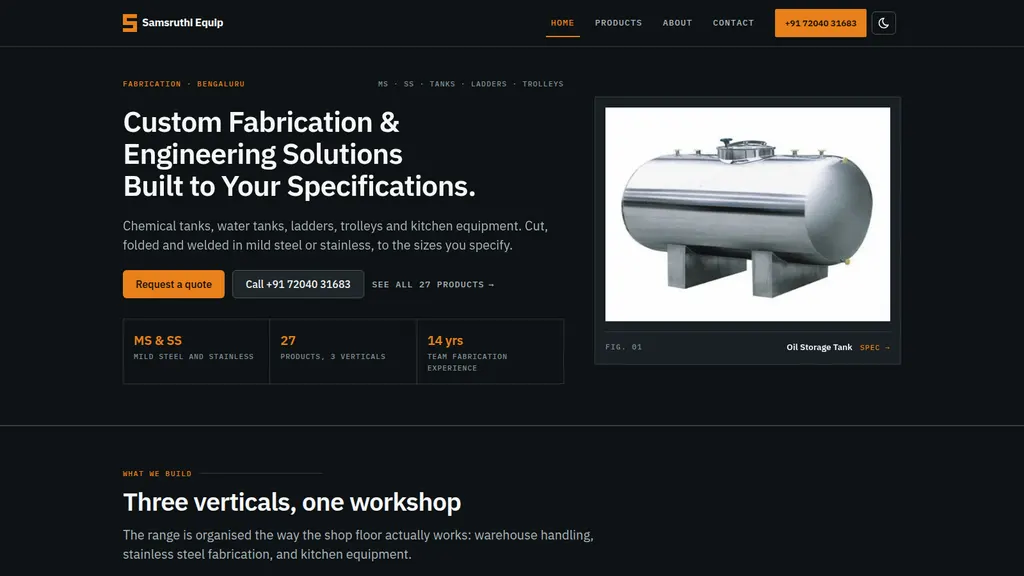
This is what that looks like in practice, using a real build — Samsruthi Equip, a fabrication workshop in Mylasandra Gate, Bengaluru, doing mild steel and stainless steel tanks, ladders, trolleys and kitchen equipment.
What “before” usually looks like
The starting point for nearly every workshop is the same. There is a WhatsApp number. There is a number of photographs taken on phones and posted into a status that disappears in 48 hours. There is a visiting card. If someone asks for a catalogue, the answer is a PDF, if one exists, usually three years old, usually a photograph of a page.
This is not a failure of effort. It works well enough, because most enquiries come from people who already know the workshop. Regular customers and referral chains keep a fabrication business busy for years without any marketing at all.
The problem is that this setup only converts people who already know you exist. It does nothing for the person who searches “SS chemical tank maker Bengaluru” at 9pm, finds nothing, and picks the workshop that appeared first.
Improvement 1: a product page for every item
The single biggest change on this build was turning a photo gallery into a catalogue where every product has its own page and its own URL.
Samsruthi lists 27 products. An MS chemical tank, an SS honey storage tank, a platform trolley, an SS bain marie, an aluminium ladder — each one is a separate page with its photograph, material options and an enquiry button.
Here is why that matters more than it sounds. A gallery can only be browsed, and most people do not browse, they search. A buyer already knows they want a chemical tank in stainless steel. They are not in a discovery mood. They type a product name into a search box and they want the page that answers them.
One page per product means every single item is a page that can be found. It means the website stops being a place you go and becomes something that turns up when somebody is already looking for you.
Twenty-seven products, twenty-seven pages, twenty-seven chances to appear in a search result for the thing you actually make.
This is the pattern most manufacturers get wrong. They build one long products page with everything on it, and they wonder why they rank for their company name and nothing else. A single long page has one title, one URL and one description. It cannot be the answer to twenty-seven different questions.
Improvement 2: group products the way the shop floor works
Need a website built properly?
Fast, modern, fully owned — from ₹7,999, delivered in 1–2 weeks.
Chat on WhatsAppSee pricingThe catalogue is not organised alphabetically, and it is not organised by price. It is grouped into four verticals:
| Vertical | Products |
|---|---|
| Tanks, Tables & Ladders | 10 |
| Stainless Steel Products | 6 |
| Kitchen Equipment | 6 |
| Warehouse Equipment | 5 |
This is how the workshop actually thinks about its own work. A buyer who runs a kitchen thinks in terms of kitchen equipment. A buyer who runs a warehouse thinks in terms of trolleys and handling. A buyer who needs a chemical tank thinks in terms of tanks and tables.
Organising by those groupings means the right shelf is always two clicks away. A buyer never has to scroll past ten tanks to find a trolley, and more importantly, a buyer who searches for “stainless steel kitchen equipment” finds a page that is actually about stainless steel kitchen equipment, rather than one long page that mentions it once.
Grouping by how the business works is also free. You are not inventing a new taxonomy for the web. You are writing down what your sales team already says on the phone.
Improvement 3: publish the made-to-order process honestly
This is the part most businesses skip, and it is the part that saves the most time.
Almost everything a fabrication workshop makes is custom. There is no price list because there is no fixed product. So the website says so, and then explains what an enquiry has to contain:
Send → Confirm → Quote
Send a drawing, a photo, or a description with the dimensions you need. The workshop confirms material, thickness and finish, and whether the sizes are fabricable. You get a price and a lead time. Nothing is ordered until you approve it.
Publishing that does two things at once.
It sets expectations. A buyer who knows a drawing is needed sends a drawing, instead of spending four messages asking “what is the price of a tank” for an item that has no price until it is measured.
And it pre-qualifies the enquiry. Every message that arrives with a drawing attached is a real enquiry. Every message that arrives as “rate for 500 litre tank?” is a conversation you did not need to have. Stating the process on the site filters the first group in and lets the second group self-select out.
There is a second reason to publish it. Buyers doing supplier checks — especially institutional and B2B ones — want to see that you have a process, published terms, and a real address. It costs nothing to put a privacy policy and terms of sale on the site, and it removes a reason for a procurement team to move to the next supplier.
Improvement 4: one tap to a human
Most of this audience is on a phone. Often it is late. Often they are at a site, not a desk, and they are looking at the actual tank they want built.
So tap-to-call and WhatsApp sit in the header, the footer, and on every product page. There is no form to fill in before a conversation can start. No address to transcribe. No “we will respond within 3–5 business days.”
That last point matters more than teams expect. In custom fabrication the enquiry is not a purchase — it is the start of a conversation that ends in a quote several days later. So the goal is not to close something on the screen. The goal is to make starting the conversation take one tap, so you are the workshop that gets the call tonight rather than tomorrow.
A contact form with a required email field, a dropdown for “service type” and a captcha loses that enquiry. It is not friction you are protecting the business from. It is friction you invented.
What this adds up to
Put those four changes together and the website starts doing something a WhatsApp status never can. It keeps working after hours. It explains your capability without you having to explain it again. It turns up in searches for the specific things you build. And it puts a one-tap path in front of someone who is already interested.
The business case is not complicated either. Compare the cost of the site against the cost of one extra enquiry a month. For a workshop where a single order is worth thousands, the site pays for itself if it produces one job. A workshop doing one or two orders a month does not need to guess at a traffic figure — it needs one enquiry that would otherwise have gone to the workshop that answered their phone faster.
When a website genuinely is not worth it
It would be dishonest to stop at the sales pitch.
A website will not help if you are fully booked and turning down work. It will not help if your enquiry process on the phone is already fast and your customers come back repeatedly. And it will not help if the real problem is pricing, or capacity, or a sales conversation — none of those are solved by a better landing page.
A fabrication website earns its cost when at least one of these is true:
- You are fully booked and want a better queue
- Some of your work is custom and hard to explain over a call
- You want to be found for specific product names, not just your company name
- Your enquiries currently arrive as a photo of a photo, with no dimensions
If none of those apply, keep doing what you are doing. If two or more do, a product catalogue with real pages and a one-tap call button is the cheapest thing you can build.
Start with the item people ask for most
If you only do one thing, do this: find the product you get asked for most often, give it its own page, and put your phone number on it. That single page will outperform a full homepage with a carousel.
Then add the second most common product. Then the third. You do not need twenty-seven pages on day one — you need the first three, and you need them findable.
Full project details, including how the catalogue is structured, are on the Samsruthi Equip project page. The site itself is at samsurthielectronics.pages.dev.
If you are a Bengaluru workshop and want the same thing for your own products, see how it works and what it costs — or send the details of the item you get asked for most, and we can tell you whether it is worth a page.
Tags
#fabrication-business-website#manufacturer-website#product-catalogue-website#made-to-order-fabrication#bengaluru-fabrication#b2b-enquiry-website