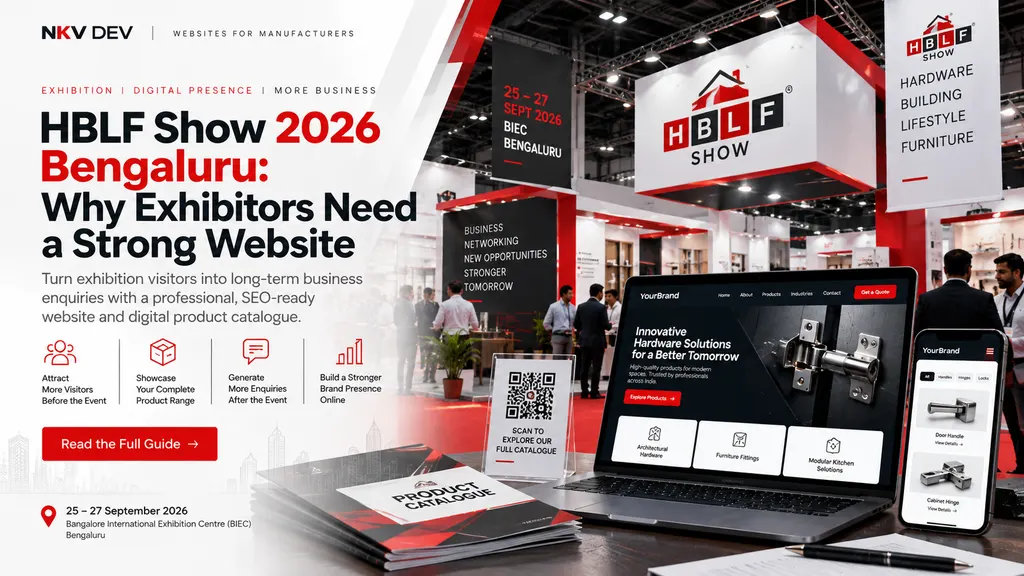
Three days at a trade show produce a contact list that goes cold within a fortnight. The buyer scans your QR code, you shake hands, they go home, and by the time anyone calls back the interest has moved to whoever replied fastest.
An exhibitor website is the fix. It is a small, fast, mobile-first site that works as a digital booth: a product catalogue, a capability page, and an enquiry form a buyer can use from the aisle without asking you to repeat your email address out loud.
This guide covers what that site needs, what it costs to build in India, and how to keep it working between shows.
What an exhibitor website actually does
An exhibitor website does one job that paper cannot: it answers the buyer’s qualification questions while you are still talking to the next person.
A visitor at a stand has about ninety seconds of attention. They will not browse. They will look at one screen, decide whether you are credible, and either scan a code or move on. The site has to work in that window, on their phone, over venue wifi.
That means four things load fast and read clearly:
- What you make. Products with photographs, sizes, materials, and whatever specification the buyer needs to qualify you.
- What you can do. Processes, capacity, tolerances, certifications. The proof that you can make their part.
- Where you have done it. Project photographs, named sectors, and ideally named clients you are allowed to name.
- How to reach you. A form that captures name, company, phone, and the requirement in one pass.
Everything else is optional. A visitor who cannot answer “do you build what I need” in ninety seconds will not fill in a twelve-field form later either.
Why booth traffic needs its own page
Trade show footfall is not website traffic. The visitor is standing, holding a phone, one-handed, on a connection that drops in the middle of a hall. Most exhibitors point that traffic at their homepage, which is a company brochure with a navigation menu and eight sections the visitor must scroll past to find anything.
An exhibitor website inverts that. The landing page a scan opens should already be the answer, with the catalogue above the fold and the form one tap away.
There is a second reason this matters. Booth traffic is the only traffic you buy without paying for ads, and it is the hardest to work twice. A visitor who scans a QR code, browses your booth catalogue on the train home, and fills the form at 11pm is worth more than the twenty people who gave you a business card and never looked again.
Treat the show as the acquisition event and the site as the follow-up. Without the second half, you paid for the hall and threw away the contacts.
What to build before the show
Need a website built properly?
Fast, modern, fully owned — from ₹7,999, delivered in 1–2 weeks.
Chat on WhatsAppSee pricingStart four to six weeks out. The build is small; the photography is what eats the schedule.
Collect your content first. For every product you intend to show, you need one clear photograph, a short description, and the specification line a buyer would ask for. Ten products done properly beats forty done badly.
Photograph at the show or before it. The stand itself is a real asset. One wide shot of the booth, plus the product displays, tells a future visitor what your stand looks like before they commit to a visit.
Write the capability page. Not marketing copy. A plain list of what you produce, in what quantities, to what tolerances, with which certifications. Buyers scan for nouns: “SS 316L”, “laser cutting”, “2000 x 4000 mm”.
Agree who handles enquiries. Booth staff can answer a form instantly if the notification reaches them, and they will ignore it completely if it does not. Decide the routing before the doors open.
Our exhibition websites service page covers the build, and digital catalogue websites covers the variant where you have hundreds of parts rather than ten.
QR code pages that survive venue wifi
The QR code is the whole mechanism, so it has to work when the venue network does not.
Venue wifi fails constantly under load, and stall-hall networks are the worst case: hundreds of exhibitors and thousands of devices on shared bandwidth. A catalogue page that depends on a fast connection will lose visitors at the exact moment you are trying hardest to reach them.
Three practical rules:
Keep the first screen light. One hero image, one heading, one call to action. If the visitor sees a spinner, they scan the next exhibitor’s code.
Host on a fast CDN. Assets should load from an edge close to the venue. This is why a static site on Cloudflare outperforms a heavy WordPress build here: it is already cached in dozens of locations and needs no origin round trip.
Design for one-handed scrolling. Large tap targets, a sticky enquiry button, and a form that works with a thumb. The visitor is holding a sample in the other hand.
Test this on the actual venue network before you commit to a design. Open the page on a phone with throttled connection and see what happens.
Turning scans into enquiries
The scan is not the outcome. The enquiry is.
Most exhibitor forms collect a name and a phone number, which produces a list with no context. Three months later nobody remembers who asked about what. Capture the requirement at the first tap, while the visitor is still holding the product they were looking at.
Fields worth having:
- Product or product category they were viewing
- Quantity, even an estimate
- Specification, material, or grade
- Target timeline
- Name, company, phone, email
That is enough to quote against without a follow-up call. A buyer who typed “SS 316L flanges, 200 off, 3 week lead time” into a form on a train is a qualified enquiry. A name and a phone number is a lead you have to qualify yourself.
Add WhatsApp as a parallel path rather than the only path. Many Indian buyers prefer it and will respond faster there, but the form is what makes the enquiry actionable. Our exhibition QR code pages service covers the setup, and exhibition landing pages covers the pre-show lead capture page.
After the show: giving enquiries a permanent home
The show ends. The website does not.
Most exhibitor sites are built for the event, taken down after it, and never touched again. That throws away the only asset you built. A visitor who was impressed in March and needs a supplier in September has no way back to you.
Keep the site up and keep it useful between shows:
- Publish new case studies from work the show generated. This is your best content and it costs nothing extra to publish.
- Update the capability page as your process range changes.
- Keep the enquiry form open. If someone enquires in June about a November requirement, you want to catch it.
- Add an exhibition calendar so buyers know when to visit your stand.
The compounding effect is straightforward: a show generates traffic for three days, and the site keeps working for the other 362. That is the difference between paying for a booth and renting one.
What an exhibitor website should include
A working exhibitor website carries the following. Every item you omit is a buyer who decides you cannot do their job.
- A mobile catalogue with photographs and specification lines, readable on a phone in a hall.
- A capability page listing processes, materials, tolerances, and capacity.
- A project gallery of real work, grouped by sector.
- An enquiry form carrying the viewing context, reachable from every page.
- WhatsApp as a parallel route, not the only route.
- A QR code on the stand, printed large enough to scan while walking.
- A downloadable profile PDF for buyers who want to forward you internally.
- Certifications with validity dates, linked as actual documents.
- A fast first load, which on venue wifi is a functional requirement rather than a nicety.
- Analytics on the enquiry form, so you know which page and which show produced the lead.
The last one matters more than people expect. If you run two shows a year, you need to know which one produced the pipeline. Our services page covers the tools for tracking submissions by source.
Website or PDF catalogue?
The honest answer is that a PDF still has a place, and the place is not the aisle.
A PDF is unsearchable, unlinkable, and invisible to Google. It cannot answer “do you fabricate SS 316L” in one tap, it will not appear in a search result, and it looks dated the moment a buyer opens it on a phone. It cannot be linked from a search listing, which means it contributes nothing to the three to six months of organic traffic that follow a show.
What it does well is the internal forward. A buyer who wants to circulate your details to a colleague wants something to attach to an email. Give them a downloadable profile PDF for that, and give them the live site for everything else.
Our digital catalogue versus PDF catalogue comparison covers the trade-offs in detail, and why your business needs a catalogue covers the structure.
SEO for exhibitors between shows
A trade show is three days. Organic search is the other 362, and it is where the compounding happens.
Buyers search for capability, not for you. They type “sheet metal enclosure manufacturer”, “SS 316L fabrication”, “custom laser cutting job work”. One exhibitor homepage cannot appear for those searches. A page per process, material, and sector can.
The structure that works:
- Service pages per process: laser cutting, CNC machining, sheet metal fabrication, welding, powder coating.
- Material pages where volumes justify it: stainless steel, aluminium, mild steel fabrication.
- Sector pages: food processing equipment, material handling, electronics enclosures.
- Project pages with photographs and specifications, each targetable for a long tail term.
Supporting it means clean titles, a sitemap, structured data, and fast pages. Buyers open these results from a plant floor on mobile data, so speed is not optional. Our SEO for manufacturers in India guide sets out the full checklist, and website for a manufacturing business covers the commercial side.
What it costs and how long it takes in India
Bands vary with scope, and they vary a lot:
- Exhibition landing page, one page per show with QR and enquiry form: roughly ₹15,000 to ₹35,000.
- Exhibitor website with catalogue, up to about fifteen products, capability page, form, CMS, technical SEO: roughly ₹40,000 to ₹1,20,000.
- Catalogue site with hundreds of parts, specification tables, and per-product images: ₹1,20,000 upward, driven by content volume rather than design.
Timeline is two to five weeks for the exhibitor tier. Most of it is content collection rather than coding, which is why starting four to six weeks before a show matters more than anything technical.
Add-ons priced separately: multilingual pages, a booking calendar, CRM integration, or a private client area with pricing.
Our pricing page lists current starting prices. If a supplier quotes you a tenth of the lower band, ask who owns the code and whether the catalogue updates without a developer, before you agree to anything.
Frequently asked questions
Should the QR code open a page built for this show, or our main site? Build a page for the show. The visitor is scanning in a hall with ninety seconds of attention. A dedicated page that opens with the catalogue and a form gets far more scans converted than a homepage they have to navigate. Keep the permanent site as the destination for follow-up, linked from that page.
Do we rebuild this for every exhibition? No. Build one exhibitor website and create a thin event page per show that points at it. The catalogue, capability page, and enquiry form stay in one place, which also means your SEO value accumulates instead of resetting each time.
How do we handle enquiries when the team is busy on the stand? Route them to WhatsApp as well as email, and agree the escalation before the doors open. Booth staff answer faster than an inbox. If a form submission takes more than a few hours to get a reply during a show, the buyer’s interest has usually moved to the exhibitor who replied in ten minutes.
Is a small site enough, or does it need updating after every show? A small, fast, accurate site is enough. Update it with new case studies from each show, and refresh the capability page when your process range changes. That is genuinely all the maintenance an exhibitor website needs.
Will this bring us leads all year, or only during the event? The site works all year; the shows bring the peaks. Organisational buyers source continuously, and a supplier they met in a hall often goes on their shortlist for a requirement that surfaces months later. Without a live site to return to, that interest has nowhere to land.
What should we publish first if we have limited content? The ten products you will actually show, with one good photograph and a real specification line each. Then your capability page, then your enquiry form. Publish before you feel ready. A small accurate catalogue beats a large incomplete one every time.
Tags
#exhibitor website#trade show website#exhibition website#b2b lead generation#digital catalogue