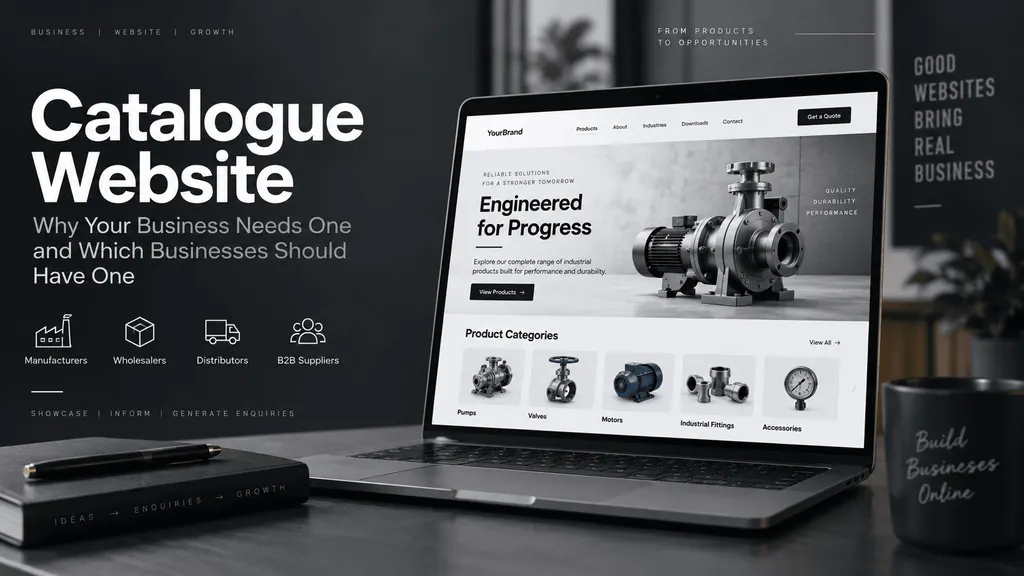
Not every business needs an online store.
If you are a manufacturer, wholesaler, distributor, supplier, or B2B company, your customers may not want to buy a product directly from your website. They may first want to see your products, understand specifications, compare options, and contact your sales team.
This is where a catalogue website becomes extremely useful.
A catalogue website is designed to showcase a company’s products or services online without necessarily allowing customers to purchase them directly. Instead of functioning like an e-commerce store, it works as a digital product catalogue and sales tool.
What Is a Catalogue Website?
A catalogue website is an online platform where a business displays its products, services, specifications, images, technical information, and other important details.
For example, a manufacturer might have hundreds of products — industrial machines, automotive components, electrical equipment, furniture, construction materials, packaging products, tools, garments, agricultural equipment, and spare parts. Putting all of these into a well-organized website lets potential customers browse the company’s complete product range from anywhere.
The website can include product categories, product images, descriptions, technical specifications, sizes and dimensions, available variants, brochures, datasheets, downloadable PDFs, certifications, company information, enquiry forms, WhatsApp or phone contact, and location details.
The key difference is that the website focuses on showcasing products rather than completing an online transaction.
Why Is a Catalogue Website Important?
For many businesses, especially B2B companies, the website is often the first place a potential customer looks before contacting the company. A professional catalogue website makes this process much easier.
Your entire product range is available online
A physical catalogue has limitations. It can become outdated, it costs money to print, and customers have to physically receive it. A website can contain your complete product range and can be updated whenever products, specifications, or availability change. Instead of sending a large PDF containing hundreds of products, you can simply send a customer your website.
One website can act as your company’s catalogue 24/7.
Customers find your products on Google
Imagine a manufacturer sells stainless steel industrial tanks. A potential customer searches Google for “stainless steel industrial tank manufacturer.” If the manufacturer’s website has properly structured product pages, those pages have an opportunity to appear in search results. Instead of relying completely on salespeople to find customers, the website can help potential customers discover the business themselves. This is particularly valuable for manufacturers and suppliers targeting B2B customers.
It makes your business look more professional
Compare two manufacturers. Company A has no website — only a WhatsApp number, manual photo sharing, and old PDF catalogues. Company B has a professional website with organized product categories, specifications, product images, company information, certifications, and enquiry forms. Even if both make similar products, Company B appears more established and easier to do business with. A catalogue website therefore becomes part of the company’s digital identity and credibility.
Which Businesses Need a Catalogue Website?
Need a website built properly?
Fast, modern, fully owned — from ₹7,999, delivered in 1–2 weeks.
Chat on WhatsAppSee pricingCatalogue websites are particularly useful for businesses that have multiple products or services but don’t necessarily need online checkout.
1. Manufacturers
A manufacturer may have dozens or even thousands of products, components, models, sizes, or configurations. Instead of creating an e-commerce store for every product, the manufacturer can create a searchable online product catalogue. Customers browse the products and then contact the company for price, quantity, customization, availability, delivery, and a quote.
2. Wholesalers
An electrical wholesaler might stock switches, cables, LED lights, distribution boards, electrical accessories, and tools. A catalogue website lets retailers quickly see what the wholesaler supplies, then directs them to “Request a Quote” or “Contact Sales” instead of requiring online payment.
3. Distributors
A distributor may represent multiple brands and carry hundreds of products. A good website organizes products by brand → category → product → specification, making it much easier for customers to find exactly what they need.
4. B2B suppliers
The price of a B2B product may depend on quantity, customer requirements, location, customization, shipping, contract terms, and bulk orders — so displaying a fixed online price doesn’t always make sense. A catalogue website showcases the product while keeping the actual sales process offline:
Industrial Pump Model X200 Capacity: 200 L/min · Material: Stainless Steel · Applications: Industrial / Chemical Request a Quote
5. Furniture manufacturers and suppliers
Furniture businesses with large ranges can display chairs, tables, sofas, office furniture, beds, cabinets, and custom furniture. Customers browse designs and contact the company about pricing, customization, and delivery — especially valuable for custom or bulk furniture.
6. Automotive parts businesses
Component manufacturers, distributors, and suppliers can organize products by vehicle, brand, model, part number, category, and application — helping workshops, distributors, and buyers find the correct component quickly.
7. Construction material suppliers
Tiles, sanitary products, pipes, roofing materials, steel products, hardware, doors, and windows — a catalogue website lets contractors, architects, and builders browse available products before contacting the supplier.
8. Textile and garment manufacturers
Textile manufacturers and garment wholesalers can display fabric types, colours, patterns, garments, sizes, collections, and customization options. For B2B customers, the website functions as a digital showroom rather than a shopping platform.
Catalogue Website vs E-Commerce Website
One common question is: “Why not just create an e-commerce website?” The answer is simple — not every business sells products in the same way.
| Catalogue Website | E-Commerce Website |
|---|---|
| Showcases products | Sells products online |
| Usually no checkout | Has checkout |
| Customers submit enquiries | Customers place orders |
| Useful for B2B businesses | Useful for direct consumers |
| Prices can be hidden | Prices are usually displayed |
| Suitable for customized products | Suitable for standardized products |
| Sales team handles quotation | Website handles transaction |
For a manufacturer selling customized industrial equipment, an e-commerce website may not be practical. A catalogue website can be much more suitable.
What Should a Good Catalogue Website Include?
A good catalogue website shouldn’t simply be a collection of product photographs. It should help customers understand what the business offers and make it easy to contact the company.
- Product categories — products organized into clear categories (for example Industrial Equipment → Pumps → Compressors → Motors → Valves) so navigation stays easy.
- Individual product pages — each important product with its own page covering name, images, description, specifications, variants, applications, documents, related products, and an enquiry button.
- Search — businesses with hundreds of products should add product search so customers don’t browse dozens of pages to find one item.
- Product filters — filters by material, size, capacity, brand, and application are extremely useful for large catalogues.
- Enquiry form — instead of “Buy Now,” a B2B catalogue website uses “Request a Quote,” “Send Enquiry,” “Contact Sales,” or “Get Pricing.”
- WhatsApp and phone contact — for many Indian businesses, customers still prefer contacting a company through WhatsApp or phone. Making these options easily accessible reduces the friction between the website visit and the actual enquiry.
We build exactly this pattern — see Digital Catalog Websites and Industrial Websites for how the categories, product pages, and RFQ workflows come together.
A Catalogue Website Can Become a Sales Tool
The biggest mistake is thinking of a catalogue website as simply an online brochure. A properly built catalogue website can become part of the company’s sales process:
Google Search → Product Page → Customer Reads Specifications → Customer Views Other Products → Customer Sends Enquiry → Sales Team Contacts Customer → Quotation → Order
The website doesn’t necessarily have to process the transaction. Its job can simply be to bring the right customer to the right product and generate a qualified enquiry.
Who Doesn’t Necessarily Need a Catalogue Website?
A catalogue website isn’t automatically the best choice for every business. A small business with only one or two services may only need a simple business website. Likewise, a company selling standardized consumer products directly to customers may benefit more from an e-commerce website.
The important question isn’t “Do I need a catalogue website?” — it is “How do my customers actually buy from me?” If customers need to see products first and then contact your business for pricing, quantity, customization, or quotation, a catalogue website can be an excellent fit.
Why Manufacturers Should Consider a Catalogue Website
For manufacturers in particular, a catalogue website can solve several problems at once. It can showcase the complete product range, generate enquiries from Google, help sales teams share products with customers, reduce dependence on printed catalogues, provide specifications in one place, improve brand credibility, work 24/7, help distributors and dealers find products, host downloadable technical documents, and generate B2B leads. Most importantly, it gives the company a permanent digital showroom.
Conclusion
A catalogue website is more than just a website containing product images. For manufacturers, wholesalers, distributors, suppliers, and other B2B organizations, it can function as a digital catalogue, product showroom, information centre, and lead-generation tool all at once.
If your customers follow a process like find product → check details → ask for price → request quote → place order, rather than add to cart → pay → receive product, a catalogue website may be a better solution than traditional e-commerce.
In today’s digital-first market, customers research a company before making an enquiry. A professional, searchable, and well-organized online catalogue makes it easier for them to understand what you offer — and easier for your sales team to turn that interest into a real business opportunity.
Ready to replace your old PDF catalogue with a website that sells around the clock? NKV DEV WORKS builds catalogue websites from ₹7,999 with full code ownership — no lock-in, no monthly hostage fees. Get a quote or see the starting prices.
Tags
#catalogue website#product catalogue website#catalogue website development#online product catalogue#digital product catalogue#B2B catalogue website#manufacturer website#manufacturer website design#manufacturer website development#website for manufacturers#website for wholesalers#website for distributors#B2B website development#product catalogue website development#business catalogue website#online catalogue for business