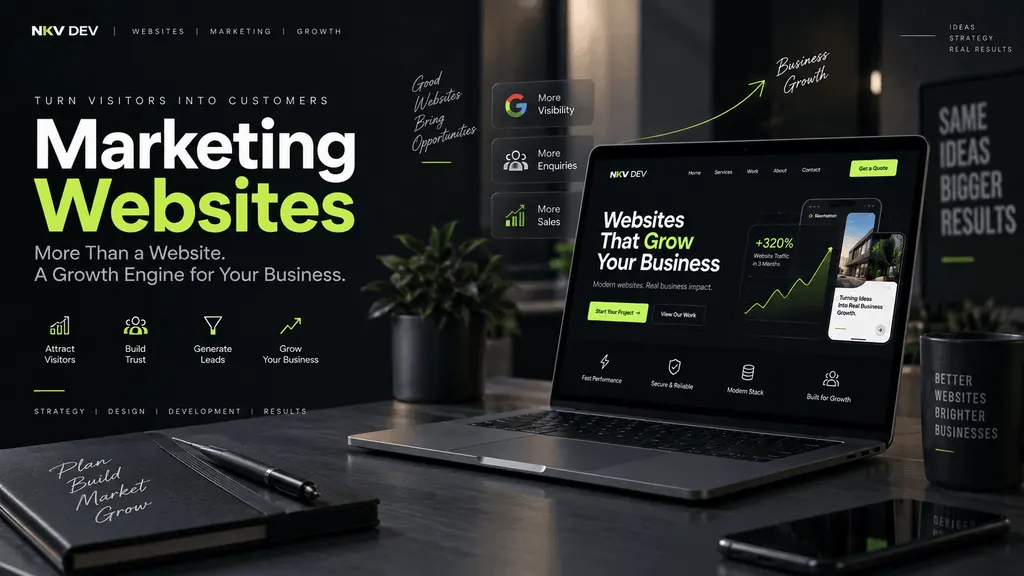
A website can do much more than simply tell people that your business exists.
A well-designed marketing website is built to attract visitors, explain your offering, build trust, and turn visitors into potential customers.
Whether you run a local business, startup, professional service, manufacturing company, agency, or personal brand, your website can become one of your most important marketing assets.
Instead of thinking of a website as an online brochure, think of it as a 24/7 salesperson for your business.
It introduces your company, explains what you offer, answers common questions, showcases your work, and gives potential customers a clear way to take the next step.
What Is a Marketing Website?
A marketing website is a website specifically designed to support a company’s marketing and customer-acquisition goals.
Its purpose isn’t simply to provide information.
It is designed around a journey:
Discover → Understand → Trust → Take Action
A marketing website might encourage visitors to:
- Request a quotation
- Call the business
- Send a WhatsApp message
- Book an appointment
- Submit an enquiry
- Purchase a product
- Sign up for a service
- Download a brochure
- Schedule a consultation
The exact goal depends on the business.
For a manufacturer, it might be “Request a Quote.”
For a restaurant, it could be “Reserve a Table.”
For a consultant, it might be “Book a Consultation.”
For an e-commerce business, it could be “Shop Now.”
A good marketing website is built around that objective.
Why Does a Business Need a Marketing Website?
1. Your Website Works 24/7
Your sales team cannot talk to every potential customer at every moment.
Your website can.
A customer can discover your business at:
9 AM
6 PM
or
2 AM
and immediately learn about your products or services.
Your website continues working even when your office is closed.
2. Turn Website Visitors Into Leads
Need a website built properly?
Fast, modern, fully owned — from ₹7,999, delivered in 1–2 weeks.
Chat on WhatsAppSee pricingGetting visitors to your website is only one part of digital marketing.
The next question is:
What happens after they arrive?
A marketing website should guide visitors toward an action.
For example:
Google Search
↓
Landing Page
↓
Understand the Service
↓
See Previous Work
↓
Build Trust
↓
Request a Quote
This is very different from a website where visitors simply read a few paragraphs and leave.
3. Build Trust Before the First Conversation
People often research a company before contacting it.
They may look for:
- Previous projects
- Customer reviews
- Company information
- Product information
- Certifications
- Experience
- Case studies
- Location
- Contact information
A professional website puts this information in one place.
For example, a potential client discovers a company through Instagram.
Instead of immediately calling, they may visit the website to learn more.
If the website clearly explains the company and demonstrates its work, the customer can make a more informed decision about whether to enquire.
4. Make Your Business Discoverable on Google
A marketing website can also become an important part of your SEO strategy.
Instead of having only one homepage, a business can create dedicated pages for its products, services, locations, and topics.
For example, a web development agency could have:
- Website Development
- E-commerce Development
- Catalogue Website Development
- Business Website Development
- Landing Page Development
- Custom Web Applications
Each page can target a different search intent.
This creates more opportunities for relevant customers to discover the business through search engines.
5. Landing Pages Can Target Specific Customers
One of the strongest features of a marketing website is the ability to create dedicated landing pages.
Imagine a company provides websites to several industries.
Instead of sending every visitor to the same generic homepage, it could create pages such as:
- Website Design for Manufacturers
- Website Design for Fashion Designers
- Website Design for Real Estate Companies
- Website Design for Restaurants
- Website Design for Clinics
- Website Design for Small Businesses
Each page can address the specific problems of that audience.
This makes the website more relevant to the visitor.
Marketing Website vs Normal Business Website
These terms can sometimes overlap, but there is an important difference in approach.
| Traditional Business Website | Marketing Website |
|---|---|
| Provides company information | Designed around customer acquisition |
| Focuses on information | Focuses on information + action |
| Basic service pages | Conversion-focused service pages |
| Contact page | Multiple conversion opportunities |
| May have a portfolio | Uses portfolio as social proof |
| General messaging | Audience-specific messaging |
| Static approach | Continuously optimized |
A business website can certainly be a marketing website.
The difference is primarily how the website is planned and designed.
What Makes a Marketing Website Effective?
A marketing website doesn’t need hundreds of animations or complicated technology.
It needs a clear strategy.
1. A Clear Value Proposition
When someone opens your homepage, they should quickly understand:
What do you do?
Who do you help?
Why should they care?
For example:
High-performance websites for growing businesses.
Then immediately explain what that means.
The visitor shouldn’t have to spend several minutes figuring out what the company actually does.
2. Strong Calls to Action
A call to action, often called a CTA, tells the visitor what to do next.
Examples include:
- Get a Quote
- Book a Call
- Start a Project
- Request Pricing
- View Products
- Send an Enquiry
- Talk to Us
A good CTA removes uncertainty.
Instead of leaving the visitor wondering what to do next, the website provides a clear path.
3. Strong Visual Design
Design matters because visitors form impressions quickly.
A professional marketing website should have:
- Consistent typography
- Good spacing
- High-quality images
- Clear hierarchy
- Responsive design
- Accessible contrast
- Consistent branding
- Fast-loading pages
The website should feel like an extension of the company’s brand.
A luxury fashion company shouldn’t necessarily have the same visual language as an industrial manufacturer.
4. Social Proof
Customers want evidence.
A marketing website can use:
- Testimonials
- Reviews
- Case studies
- Client logos
- Certifications
- Awards
- Project results
- Portfolio examples
For example:
See how we helped a local business generate more enquiries through its website.
A detailed case study can be much more convincing than simply saying:
“We build great websites.”
5. Fast Performance
A beautiful website that takes too long to load can still create a poor experience.
Performance is particularly important for mobile users.
A marketing website should minimize unnecessary:
- JavaScript
- Large images
- Third-party scripts
- Unused CSS
- Heavy animations
Modern web technologies such as Astro, optimized static content, responsive images, CDNs, and edge hosting can help developers build fast websites.
At NKV Dev, performance is considered part of the development process rather than something to fix at the very end.
6. Mobile-First Experience
Many potential customers will discover a business from their phone.
That means a marketing website should work properly on:
Mobile → Tablet → Desktop
Buttons should be easy to tap.
Text should be readable.
Images should load efficiently.
Forms shouldn’t be frustrating to complete.
The mobile version shouldn’t feel like a smaller version of the desktop website.
It should be designed as a proper experience.
Marketing Websites and WhatsApp
For many Indian businesses, WhatsApp is an important communication channel.
Instead of forcing a potential customer through a complicated contact form, a website can provide a direct WhatsApp enquiry option.
For example:
Interested in this product?
Chat with our sales team on WhatsApp
This can create a simple journey:
Website → WhatsApp → Sales Conversation
The exact conversion method should depend on how the business normally communicates with customers.
Marketing Websites for Different Types of Businesses
Almost any business can use a marketing website, but the strategy will differ.
Local Businesses
Examples:
- Restaurants
- Salons
- Gyms
- Repair services
- Interior designers
- Photographers
- Local retailers
Important features may include:
Location + Services + Reviews + Contact + WhatsApp
Manufacturers
Manufacturers can use their websites to showcase:
- Products
- Specifications
- Applications
- Certifications
- Manufacturing capabilities
- Industries served
The primary CTA might be:
Request a Quote
Professional Services
Examples:
- Lawyers
- Consultants
- Accountants
- Architects
- Designers
- Agencies
The website can focus on:
Expertise + Services + Case Studies + Trust + Consultation
Startups
Startups often need their website to explain a new product or idea quickly.
A startup marketing website may include:
- Problem
- Solution
- Product
- Features
- Benefits
- Testimonials
- Pricing
- FAQ
- CTA
The objective is to help visitors understand the product quickly.
Marketing Website + SEO + Advertising
A marketing website becomes even more useful when combined with other marketing channels.
For example:
Google Search
↓
SEO / Search Advertisement
↓
Marketing Website
↓
Landing Page
↓
Lead
Similarly:
↓
Website
↓
Product / Service Page
↓
↓
Customer
The website becomes the central destination connecting different marketing channels.
Don’t Build a Website Just to “Have a Website”
One of the biggest mistakes businesses make is creating a website without defining what the website is supposed to accomplish.
Before development starts, ask:
Who is the customer?
What problem are they trying to solve?
What information do they need?
Why should they trust us?
What action should they take?
How will we measure success?
These questions should influence the structure of the website.
How We Approach Marketing Websites at NKV Dev
At NKV Dev, we don’t see web development as simply writing code and deploying pages.
A marketing website combines several disciplines:
Strategy
↓
Content
↓
Design
↓
Development
↓
SEO
↓
Performance
↓
Conversion
The technology is important, but technology alone doesn’t generate customers.
A fast website with confusing messaging can still perform poorly.
A beautiful website without a clear CTA can still lose potential leads.
A website with excellent content but poor performance can create a frustrating experience.
The best results come from considering the entire system.
Technology Behind a Modern Marketing Website
Depending on the project, a modern marketing website can use technologies such as:
- Astro
- React
- TypeScript
- Cloudflare
- Modern CSS
- Component systems
- Content management systems
- Analytics
- Search optimization
- APIs
- Forms and automation
For a content-heavy website, Astro can provide a strong foundation for delivering lightweight pages.
For highly interactive applications, React may be more appropriate.
For backend requirements, APIs and databases can be introduced.
The technology should follow the requirements—not the other way around.
How Do You Measure a Marketing Website?
A website shouldn’t be judged only by how attractive it looks.
You can also measure:
Traffic
How many people visit?
Search Visibility
Which keywords bring visitors?
Engagement
Are visitors exploring multiple pages?
Leads
How many enquiries are generated?
Conversion Rate
What percentage of visitors take the desired action?
Qualified Leads
Are the enquiries coming from people who actually need the service?
Business Results
Are website-generated leads turning into actual customers?
These metrics provide a much better understanding of whether the website is contributing to the business.
Your Website Is Part of Your Marketing System
A marketing website doesn’t operate in isolation.
It can connect:
SEO
Social Media
Google Ads
Content Marketing
Sales
Analytics
into one digital customer journey.
That’s why website development should be considered part of a company’s marketing strategy rather than simply a technical project.
Conclusion
A marketing website is designed to do more than display your company’s information.
It helps potential customers:
Find you → Understand you → Trust you → Contact you
For a small business, it can generate local enquiries.
For a manufacturer, it can showcase products and generate quotation requests.
For a startup, it can explain a new product.
For a professional service provider, it can establish credibility and generate consultations.
For an e-commerce company, it can guide customers toward products and purchases.
The most important thing is to build the website around the customer journey and business objective.
At NKV Dev, we believe a website should not simply exist online.
It should have a purpose.
Want a website built around your business goals? Get in touch or explore our web development services.
Tags
#marketing-website#marketing-website-for-business#business-marketing-website#marketing-website-development#website-for-lead-generation#lead-generation-website#conversion-focused-website#conversion-focused-web-design#business-website-design#website-marketing#digital-marketing-website#seo-website-development#seo-friendly-website#landing-page-development#business-landing-page#website-conversion-optimization#website-for-small-business