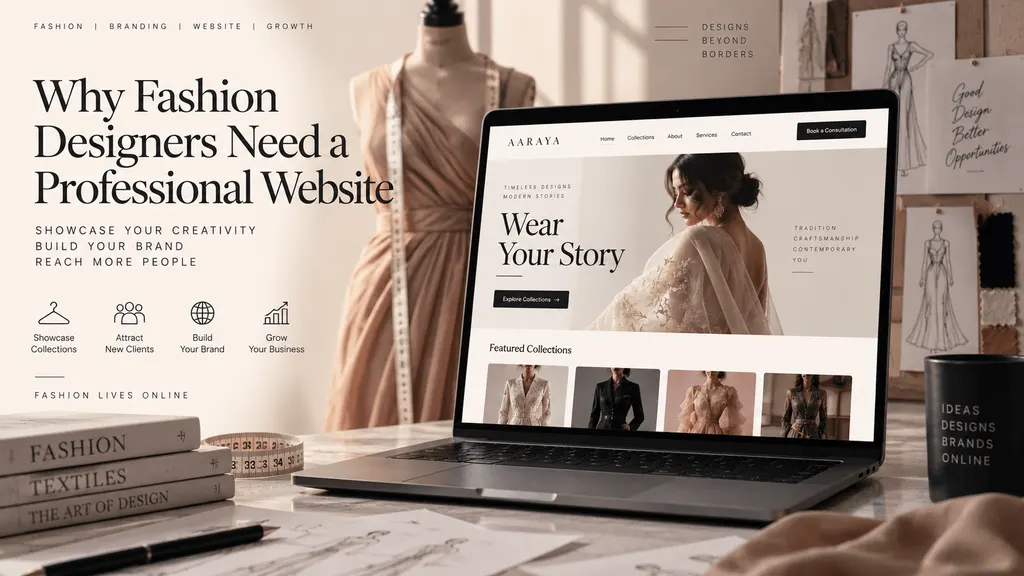
Website for Fashion Designers and Tailors: A Practical 2026 Guide
If you are a fashion designer or a tailor, your work is usually judged in person: the fall of a lapel, the line of a shoulder, the accuracy of a hem. Most of your next clients will judge you on a screen first. A website for fashion designers and tailors is the only channel where you control that first impression, show the craft in full, and keep the enquiries you paid to earn. This guide covers what the site must include, how it should look, what it costs in India, and how to avoid the template traps that make handmade work look mass-produced.
Why a website still beats Instagram and WhatsApp
A website converts strangers into paying clients because you control the story, the offer, and the follow-up, while social platforms only let you rent that attention. Instagram is a discovery engine, not a shopfront: it decides who sees your last collection. A site is the opposite. It works on the day you post and on the days you are busy at the machine, and it is a link you can put in a bio, an email signature, or a Google profile without asking a platform for permission.
Google and Deloitte’s study Milliseconds Make Millions found that a 0.1 second improvement in mobile site speed lifted retail conversions by 8.4%, and a site you own is the only asset where that gain compounds for you. Ownership matters most in a craft business. As designer Corrado Manenti puts it, “Your portfolio website is your virtual showroom. It must convey the same care and attention that you put into your garments.” A showroom you own also lets you collect an email list, so a fabric shortage or a quiet month does not erase your audience overnight.
What a website for a fashion designer or tailor must include
Need a website built properly?
Fast, modern, fully owned — from ₹7,999, delivered in 1–2 weeks.
Chat on WhatsAppSee pricingA website for fashion designers and tailors answers three questions in a minute: who you are, what you make, and how to start. Build the pages around how people actually buy bespoke and made-to-measure clothing, not a generic template.
The essentials:
- A hero showing one signature piece or a short film of fabric in motion.
- Collection or service pages, one per line, so bridal, alterations, and ready-to-wear never compete for one click.
- A process page covering consultation, measurements, fittings, and delivery.
- A lookbook with high-resolution images and close-ups of fabric and stitching.
- An enquiry form with a stated response time, because bespoke work starts with a conversation.
- An About page with your training, your philosophy, and the reason your fit is different.
- Press mentions and client testimonials that prove strangers trust you.
- A mobile-first layout, since most traffic arrives on a phone after a recommendation.
Group these into clear pages rather than one long scroll. A structured services page and a portfolio that separates finished commissions from process shots beat a single gallery every time. If you sell accessories or made-to-measure pieces, a digital catalogue keeps each one readable rather than burying it in a grid.
Portfolio or online store: which one does your studio need?
Choose a portfolio site if your money comes from commissions, fittings, or B2B work, and choose an online store if you sell repeatable products at a fixed price. Most designers and tailors should start with a portfolio and add commerce later, once a product line reliably sells out.
A portfolio fits when the sale depends on trust and a fitting. It is lighter, faster to launch, and it positions you as a studio rather than a discount rack. A good enquiry is worth more than a low-value order. An online store makes sense when you sell patterns, gift cards, accessories, or seasonal ready-to-wear, because those items sell without a fitting and the store can run while you work. When you reach that point, a proper e-commerce build with size variants, fabric options, and secure checkout pays for itself quickly.
You do not have to decide forever. The best approach is to launch the portfolio with a shop-ready structure, so adding products later is a configuration change, not a rebuild. That saves you from paying twice.
Showing fabric, drape, and stitching on a screen
Show the making, not only the finished garment, because process images communicate quality that a flat product shot never will. Buyers cannot touch the cloth through a screen, so your job is to make them feel it through light, motion, and detail.
Shoot three kinds of image: a full look worn and moving, a macro shot of the stitching or fabric weave, and a behind-the-scenes frame such as a sketch, a toile, or a hand marking a pattern. Video is not optional in this niche. A ten second loop of a coat turning in daylight tells a buyer more about the hand of the fabric than a paragraph of copy. Keep styling consistent across every page: the same light and palette. Stock photography undoes this, because a visitor recognises it and assumes your garments are equally generic.
Finally, respect the weight of your images. A beautiful campaign shoot can sink a mobile page if the files are huge. Serve modern formats such as WebP, size images to the screen, and load them in the order the visitor sees them.
Getting found by local clients: SEO for tailors and designers
Local search is where tailoring and made-to-measure commissions are won, because clients search for a service near them before they ever ask a friend. BrightLocal’s local consumer research has repeatedly found that around 98% of people read online reviews for local businesses, which makes your storefront profile and your reviews as important as your homepage.
Start with a complete Google Business Profile: correct category, your area, hours, and fresh photos of recent work. Then build one clear page per service and city, so “bespoke blouse stitching in Bengaluru” has a page to land on instead of a generic form. Collect reviews after every fitting, and reply to them. On the site, keep headings honest, describe services in the words clients use, and earn links from local press or supplier directories. A focused local page beats a thin national one. If you would rather hand this off, a partner who already builds local search ready websites can wire the structure from day one, including the reviews and service pages that earn the click.
The speed standard clients feel but never mention
Speed is the invisible bottleneck: visitors rarely complain about a slow site, they simply leave. Google’s Core Web Vitals are the published standard for loading speed, visual stability, and interaction, and they are worth building for whether or not you watch rankings.
Aim for a page that is useful in under a second, with no text that jumps as fonts and images arrive. That means compressing images, subsetting fonts, and avoiding heavy page builders that drag one photo behind three plugins. For a small studio site this is achievable without a large budget, because the content is mostly images and text. Test on a real mid-range phone over mobile data rather than on your studio desktop, and repeat the test after every new collection is uploaded. A site that feels instant protects the premium impression you are paying photographers to create.
What a website for a fashion designer or tailor costs in India in 2026
In India, a website for fashion designers and tailors typically sits between about 15,000 and 40,000 rupees for a portfolio, while a store with payments and inventory usually runs from 40,000 rupees upward depending on the number of products and the integrations. The exact number depends on scope, not on the size of your brand.
A simple one-page presence with contact details and a small gallery is the entry point. A studio build adds multiple service pages, a lookbook, an enquiry pipeline, and local SEO, which is where most established tailors and designers land. A store adds product management, payment gateways, shipping, and size or fabric variants. Be sceptical of a cheap quote that hides a monthly template subscription; over three years it often costs more than a custom build. Our full pricing page breaks the packages down, including what is and is not included, so you can compare quotes honestly.
Own your code and your customer list
The biggest trap in fashion websites is rental: you pay a builder or a theme every month and still do not own the file, the data, or the design. Own the code and the email list, and the website becomes an asset instead of a subscription.
Template platforms are convenient until you want to move, change a layout, or stop paying, at which point the site you funded stays with the platform. A custom build is yours to host anywhere, and your enquiries stay in your own database and inbox. That ownership is also cheaper over time, because there is no platform fee to keep the site alive. This is the angle most fashion and tailor website guides skip, because the agencies writing them resell the subscription. If full ownership matters to you, an owner-built website that ships clean, fast code and a real contact list is the safer long-term investment.
Frequently asked questions
How long does it take to build a website for a fashion designer or tailor? A focused portfolio takes two to four weeks from kickoff, if copy and images are ready. A store with payments and inventory typically takes six to ten weeks.
Do I need an online store if I mainly take bespoke orders? No. A portfolio with a strong enquiry form is often the higher-value choice, because bespoke work is sold through a conversation and a fitting rather than a checkout.
How many photos should I upload? Quality beats quantity. Ten to twenty excellent images, covering full looks, fabric close-ups, and process shots, outperform a hundred rushed ones.
Can I update the site myself after launch? Yes, if the build is set up for it. A content-managed site lets you add a new collection or a testimonial without touching code.
Will a website actually bring me clients? It will if it targets local searches, loads fast, and makes contacting you effortless. Treat it as the destination for every recommendation and business card, not a replacement for word of mouth.
Tags
#website for fashion designers and tailors#fashion designer website#tailor website#bespoke website#fashion portfolio website#website cost in india#local seo for fashion