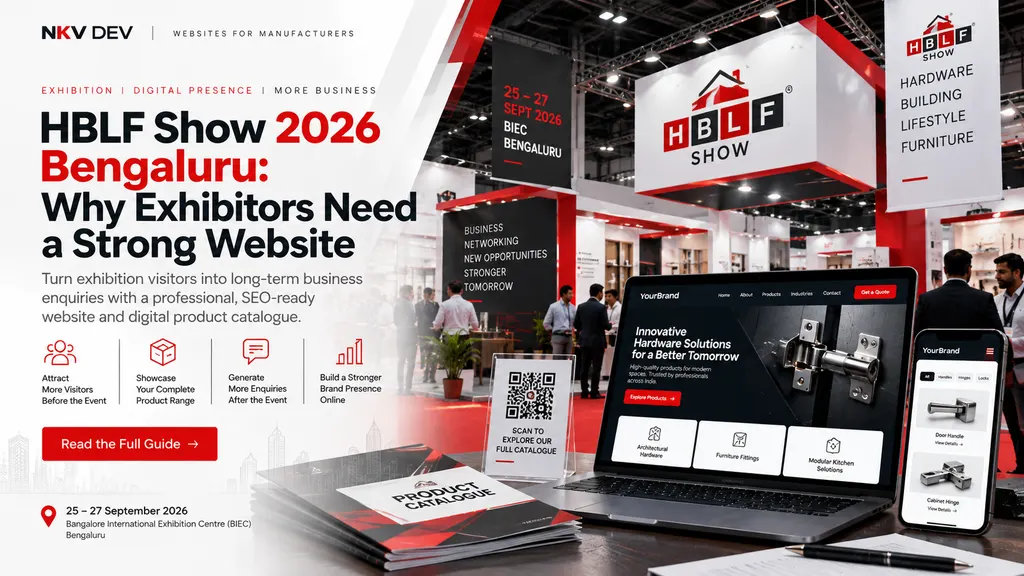
If you are exhibiting at HBLF Show 2026 in Bengaluru, your website should do more than display a logo and a contact number. It should help a visitor understand what you manufacture, find the right product, save the information they need and continue the conversation after the exhibition ends.
The official HBLF Show 2026 website lists the event for 25–27 September 2026 at the Bangalore International Exhibition Centre (BIEC), Bengaluru. The show brings together architectural and interior hardware, building materials, laminates, lighting, modular kitchens, furniture, machinery and related B2B industries. See the official HBLF Show website for the organiser’s current information.
This guide explains how exhibitors can use a professional website before, during and after HBLF Show. It is written for manufacturers, suppliers, distributors, brands and sales teams that want more from the show than short-lived booth traffic.
Independent editorial disclosure: NKV DEV WORKS is not the organiser, sponsor or official partner of HBLF Show. This guide is an independent website and lead-generation resource. Event details and downloads link to the organiser’s official pages.
HBLF Show 2026 at a glance
| Detail | What the organiser lists |
|---|---|
| Dates | 25–27 September 2026 |
| Venue | Bangalore International Exhibition Centre (BIEC), Bengaluru |
| Event focus | Hardware, Building, Lifestyle and Furniture industries |
| Exhibitor information | Official exhibitor page |
| Visitor information | Official visitor page |
| Planning material | Download the official HBLF floor plan |
The HBLF exhibitor page is the right place to confirm participation, registration and show details. Use the organiser’s pages for event information rather than relying on an outdated third-party listing.
Why a website matters for an HBLF exhibitor
A physical stall is temporary. It exists for the show dates, while a website can continue explaining your products for months. That difference matters when a buyer collects several business cards at the exhibition and researches the companies later.
The most useful exhibitor website gives a visitor a short path from interest to action:
HBLF Show booth → scan or visit your website → explore products → check specifications → request a quote or WhatsApp your sales team
Without that path, the visitor has to remember your company name, search for it later and hope your homepage appears at the top of the results. A focused website removes that uncertainty. It lets a buyer confirm the company, products, location, capabilities and contact details while your product is still in their hand.
This is especially important for a B2B catalogue. A visitor may not be ready to buy at the stall, but they may be collecting information for an architect, distributor, contractor or procurement team. Your website becomes the reference they can send to colleagues.
Before HBLF Show: make your company easy to find
Need a website built properly?
Fast, modern, fully owned — from ₹7,999, delivered in 1–2 weeks.
Chat on WhatsAppSee pricingThe strongest exhibitor marketing starts before the event. Potential buyers may see your company in an exhibitor list and search for it before deciding which stalls to visit. Make the search result useful in the first few seconds.
Your homepage should answer five questions immediately:
- What does your company manufacture or supply?
- Which product categories do you offer?
- Who do you serve, and which industries use your products?
- What makes your products or capabilities credible?
- How can a buyer request a quote, download a brochure or speak to sales?
Do not make visitors infer the answer from a carousel of exhibition photographs. Use clear headings, real product images, concise specifications and a visible enquiry action. A search visitor should be able to understand the company without scrolling through a long corporate presentation.
If your catalogue is broad, create pages for the categories buyers search for rather than putting every product in one long homepage. A page for architectural hardware, a page for door fittings and a page for lighting answers more specific questions than a generic “Products” heading.
At HBLF Show: connect the booth to a mobile catalogue
Most exhibition visitors will scan a QR code or type a URL on their phone. That makes mobile performance and clarity part of the booth experience, not a technical afterthought.
A practical exhibitor flow is:
- Place a QR code at the booth or product display.
- Open a fast, mobile-friendly product or category page.
- Show clear images, variants, applications and specifications.
- Offer a relevant next action: View specifications, Download the brochure or Request a quote.
- Connect the action to WhatsApp, a form or a sales inbox.
The QR destination should be specific. A generic homepage may be convenient, but a product page is more useful when the visitor is standing in front of that product. If several products share one display, use a category page with filters or sections rather than sending every scan to the same generic page.
Keep the first screen simple. The visitor may be standing in a busy aisle with one hand holding a phone and the other holding a sample. The page should load quickly, use readable text and make the enquiry action obvious.
NKV DEV builds exhibition websites, digital catalogue websites, QR-led exhibitor pages and industrial websites around this scan-to-enquiry journey. For a broader overview, see our BIEC exhibition website service.
After the show: give every enquiry a permanent home
The show ends, but the conversations do not have to. A buyer may need a week to compare products, ask a technical team for dimensions or circulate a catalogue internally. Your website should let that buyer pick up where the conversation stopped.
Create permanent pages for:
- Product families and individual products
- Materials, dimensions, tolerances and other specifications
- Applications and industries served
- Manufacturing processes and equipment
- Certifications and downloadable technical documents
- Company location, plant capabilities and contact details
- Enquiry forms or WhatsApp conversations tied to a product
A salesperson should be able to send one product page after a discussion instead of attaching a large PDF that is difficult to open on a phone. The page can act as a stable reference for the buyer and a useful handoff for the sales team.
This is where a digital catalogue becomes more than a show brochure. It becomes a product-discovery and lead-capture system that remains available after the physical exhibition.
What an HBLF exhibitor website should include
A useful exhibitor site does not need a large number of pages. It needs the right information in a structure a buyer can understand.
Product and category pages
Give every major product family its own page. Include:
- A plain-language product name
- Current product photographs
- Materials, sizes, finishes or technical specifications
- Variants and available options
- Common applications
- A relevant brochure or technical download
- A product-level enquiry action
Keep important specifications in HTML. A PDF can be a useful secondary download, but buyers and search engines should not have to rely on a document to understand the page topic.
Capability and trust pages
B2B buyers want evidence before they contact a supplier. Add pages or sections for:
- Manufacturing or distribution capabilities
- Quality processes and testing
- Certifications and registrations
- Markets served and geographic coverage
- Plant, equipment or warehouse details
- Real projects or case studies, where permission exists
Use specific evidence. “High quality” is weaker than a documented tolerance, certification, process or project result.
Mobile enquiry paths
Offer more than one clear way to make contact. A visitor may prefer a phone call, while a procurement team may want a structured RFQ form. Let the user choose.
For a form, ask only for information the sales team needs to respond. Product interest, quantity, company and a usable contact method are often more valuable than a long list of optional questions. Connect the form to a monitored inbox and provide a visible WhatsApp option for quick follow-up.
SEO for HBLF exhibitors after the event
The exhibition gives you attention. Search can turn that attention into a steady stream of relevant visitors long after the booth is gone.
Start with the questions your buyers actually type. These may include combinations of a product, material, application, city or business type. Build one useful page for each distinct topic rather than repeating the same paragraph across many URLs.
For example, a manufacturer might create pages for:
- Architectural hardware products
- Door and window fittings
- Modular kitchen components
- Lighting products
- Building materials and accessories
- A city or service-area page where it genuinely operates
Publish specifications, product images and application guidance in the page body. Add relevant internal links between categories, capabilities and contact pages. Our guide to SEO for manufacturers in India covers the technical and content foundations in more detail.
The website should also make its business identity consistent. Use the same company name, address, phone number and descriptions across the site, Google Business Profile, directories and social profiles. A buyer should not have to guess whether two similar company names are the same supplier.
Technical SEO is not a substitute for a good product catalogue, but it helps the catalogue get found. Keep pages indexable, use self-referencing canonical URLs, submit the sitemap to Search Console and check the pages that receive impressions. A static, fast website is a good foundation for an exhibition funnel because it remains useful on ordinary mobile connections after the event.
A website or a PDF catalogue?
A PDF is useful for a visitor who wants something to take away. It is not a complete website.
A PDF can be difficult to search, easy to share without context and awkward to open on a phone. It also cannot provide a clean path to an enquiry, a related product or a later update. Use it as a downloadable brochure alongside a mobile catalogue, not as the only place where your products exist.
For many HBLF exhibitors, the simplest useful combination is:
- A fast company and product website
- A mobile category catalogue
- A downloadable PDF brochure
- A QR code at the booth
- A product-aware WhatsApp or RFQ form
That combination supports a buyer who scans at the show, forwards a product page to a colleague and returns for more information later.
HBLF exhibitor website checklist
Before the show opens, check that you can answer “yes” to these questions:
- Does your homepage state what your company manufactures or supplies?
- Can visitors find products by category on a phone?
- Are product images current and clearly labelled?
- Are important specifications written in HTML?
- Can a visitor download a relevant brochure?
- Does every QR code open the intended page quickly?
- Is there a visible WhatsApp, phone or enquiry action?
- Can the sales team identify which product or page generated a lead?
- Are company name, address and phone details consistent?
- Does the website load without broken pages or console errors?
- Is the site crawlable and included in the sitemap?
- Do you have a plan to follow up after the show?
Do not wait until the venue to discover that a product page is missing, a form fails or a large image makes the catalogue slow.
Frequently asked questions
What is HBLF Show 2026?
HBLF Show 2026 is a B2B exhibition for hardware, building, lifestyle and furniture industries. The organiser lists the show for 25–27 September 2026 at BIEC in Bengaluru. Check the official website for the latest event information.
Where can I download the HBLF floor plan?
The organiser publishes a downloadable floor-plan PDF for the show. Use the official HBLF floor plan and confirm details with the organiser before making travel or layout decisions.
Should an HBLF exhibitor have a product catalogue website?
Yes, if you want the show to generate enquiries after the exhibition. A mobile catalogue gives visitors a permanent place to review products, specifications and contact options, while a PDF remains useful as a take-away brochure.
Is NKV DEV WORKS affiliated with HBLF Show?
No. NKV DEV WORKS is an independent website development company and is not the organiser, sponsor or official partner of HBLF Show. We provide independent guidance and link to official organiser pages for event information.
What should a QR code at an HBLF booth open?
It should open a fast, mobile-friendly page relevant to the product or category at the booth. The page should show clear images and specifications, then offer a simple action such as requesting a quote, downloading a brochure or contacting the sales team on WhatsApp.
How long should an exhibitor website be live?
At least as long as your products are sold. A current catalogue and enquiry flow can support buyers who saw you at HBLF Show months later, support distributors and help your company appear in organic search for relevant product searches.
Make the show the start of the conversation
HBLF Show 2026 can put your products in front of buyers, architects, distributors and industry professionals. Your website gives that first interaction somewhere to go next.
Before the event, make your company easy to search. During the event, connect the booth to a fast mobile catalogue. After the event, give every product, specification and enquiry a permanent home.
If you need a website, product catalogue or QR-based exhibitor page for HBLF Show, view our website development services, see the pricing or contact NKV DEV WORKS for a focused quote.
For official event registration and exhibitor details, use the HBLF exhibitor page. For visitor information, see the official visitor page.
Tags
#HBLF Show 2026#HBLF Show Bengaluru#exhibitor website#manufacturer website#exhibition website